
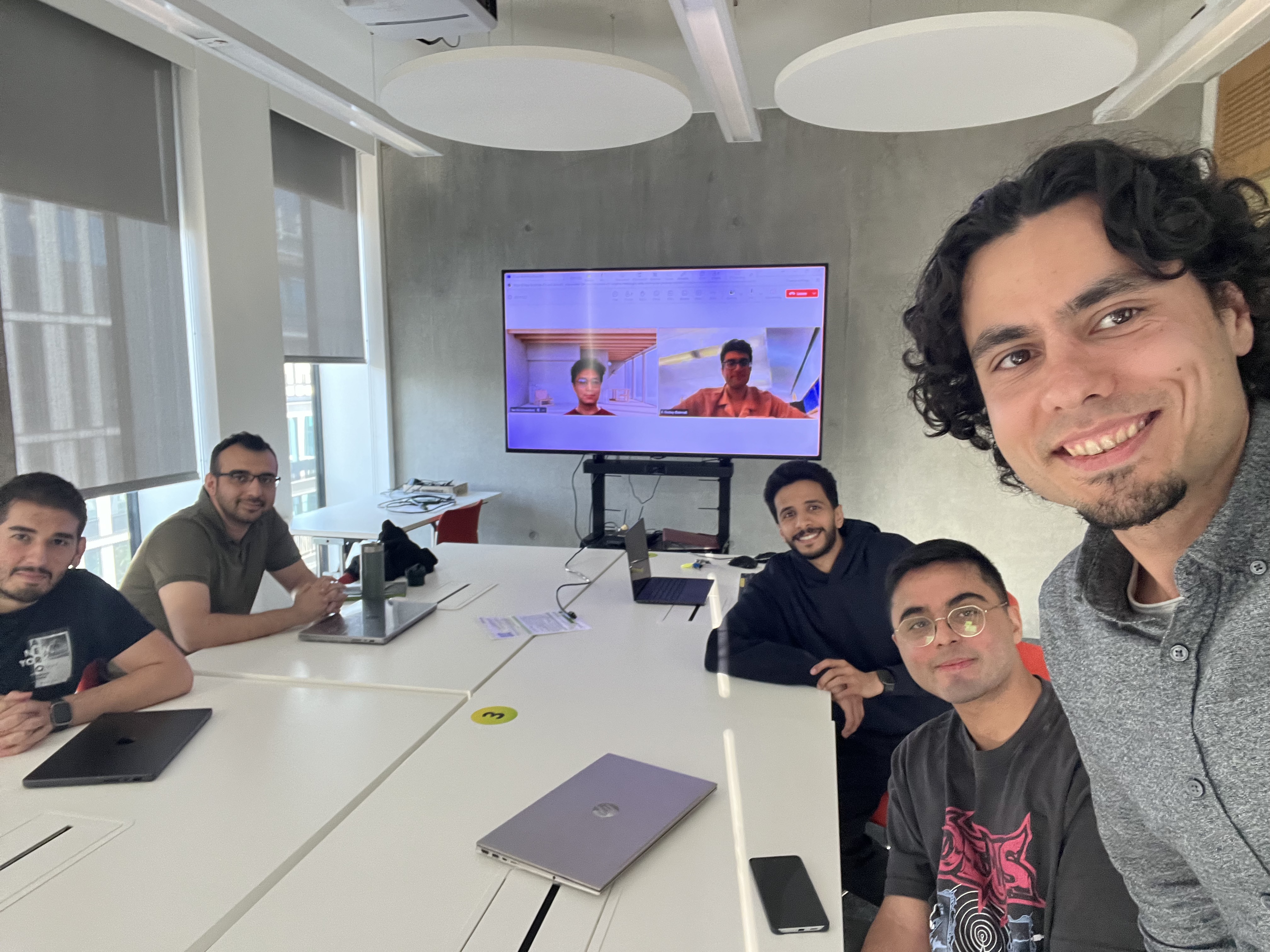
Team
- Yusuf Mücahit Çetinkaya (Postdoc)
- Riyadh Alnasser (PhDc)
- Onat Özdemir (PhDc)
- Sholpan Bolatzhanova (PhDc)
- Dhyey Mehta (Undergrad)
- William Whitfield (Undergrad)
- Yining Wang (External supervision)
- Negar Alizadeh (External supervision)
Alumni
- Serdar Kara (Undergrad)
- Alp Eren Köken (Undergrad)
- Ömer Bıçakçıoğlu (Undergrad) → Indiana University Bloomington
- Basem Mohammed (Undergrad) → imec
- Erencem Özbey (Undergrad) → University of Illinois Urbana-Champaign
- Kaho Suzuki (MSc) → IBM Japan
Projects
AI-Generated Media & Social Media Manipulation Detection
We study how false and misleading content spreads on social media — from coordinated inauthentic behaviour and state censorship to AI-generated deepfakes and synthetic media. We build detection methods and characterize the impact of these threats on public discourse.
- TRACE-Inset: Unified Whole-Image and Partial-Match Image Retrieval with Vision-Language Embeddings — Preprint
- Humans Cannot Detect AI-Generated Media But Communities May — For Now: Collaborative AI Detection in r/RealOrAI on Reddit — Preprint
- Misleading Repurposing on Twitter — ICWSM 2023
- Ephemeral Astroturfing Attacks — Euro S&P 2021
Human–AI Interaction
We study how people interact with AI assistants in high-stakes and sensitive domains — from romantic relationships and mental health support to legal and medical advice. A central question is how LLMs handle disagreement: when they defer, push back, or subtly steer a user's views. This connects to broader questions of epistemic authority — how AI systems shape what people believe, how they reason, and whom they trust.
🏆 Awarded Generative AI Lab Seed Funding (£2,500): Can LLMs Give Relationship Advice?
Computational Social Science
We apply computational methods to understand large-scale social phenomena — including cross-partisan dynamics, political discourse across platforms, gender in online communication, and the methodological challenges of studying social media data.
Automating Science & Education
We explore how LLMs and multi-agent AI systems can accelerate scientific workflows and transform education — from automated opinion mining and structured election analysis to orchestrating agent collaborations that produce full data science research papers end-to-end. We are also building AI-assisted teaching tools and studying the epistemic implications of delegating scientific reasoning to generative models.
- ChatGPT vs Teachers vs Students: Large-Scale Analysis of Generative AI Discourse in Education Communities on Reddit — ICWSM 2027
- An Optimistic Outlook on Teaching, Learning and Assessment for Coding With the Emergence of Generative AI — Book Chapter
- Opinion Mining from YouTube Captions Using ChatGPT — arXiv 2023